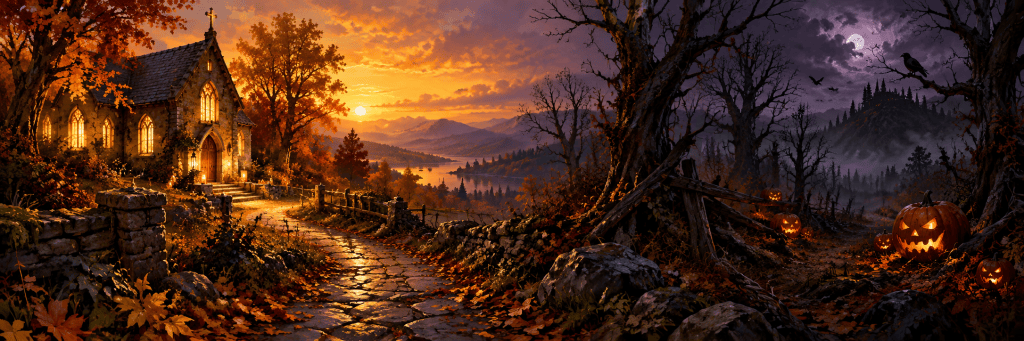
Halloween raises a question that deserves more than a quick yes or no: How should followers of Jesus respond to a cultural celebration that mixes childhood fun, old folklore, commercial entertainment, and sometimes unmistakably occult themes? The issue is not simply what a custom once meant. It is also what we are actually doing, what we are celebrating, and whether our conduct honors Christ.
The History Behind the Holiday
Halloween has a complicated history. The ancient Celtic festival of Samhain marked the movement from the harvest season into winter. Later folklore associated this season with the dead, spirits, divination, and the thinning of boundaries between the visible and invisible worlds. Our knowledge of ancient practices is incomplete, however, and we should be cautious about presenting every modern Halloween custom as a direct survival of a Druid ritual.¹
The Christian calendar added another layer. All Saints’ Day, also called All Hallows’ Day, came to be observed on November 1; the preceding evening became All Hallows’ Eve, from which the word Halloween developed. All Souls’ Day is observed on November 2. The precise relationship between these observances and Samhain is debated, but the modern holiday clearly reflects a mixture of religious, folk, and secular influences.²
Costumes, carved lanterns, and door-to-door visits have their own varied histories. Lanterns were once carved from turnips in parts of the British Isles; pumpkins became popular in North America. Trick-or-treating may draw from several customs, including guising, souling, and later American community practices. It is historically too simple to say that a child asking for candy is reenacting an ancient offering to spirits.³
What Should Concern Christians
A historical connection does not automatically determine the meaning of every present-day activity. Nevertheless, some practices are not merely symbolic or playful. Attempts to contact the dead, conjure spirits, divine the future, or invoke supernatural powers stand in direct conflict with Scripture. God calls His people to seek Him, not hidden powers. The biblical prohibition addresses real spiritual allegiance and conduct, not the mere presence of an autumn decoration.
Deuteronomy 18:9–14 forbids divination, sorcery, and consulting the dead. Leviticus 19:31 warns against turning to mediums. Isaiah 8:19 asks the penetrating question: “Should not a people seek their God?” The New Testament likewise calls believers to renounce the works of darkness (Ephesians 5:8–11) and to refuse participation in idolatry (1 Corinthians 10:14–22).
Christians are children of light. Our concern should be more than avoiding an objectionable symbol; it should be living in a way that visibly belongs to Jesus. The question is not whether we can turn a dark theme into amusement without consequences. The deeper question is whether we are cultivating love for what is true, pure, and pleasing to God.
Christian Liberty and Christian Responsibility
Scripture also teaches us to distinguish explicit commands from matters requiring wisdom. Paul acknowledges that food associated with idols does not automatically become spiritually contaminated, yet he forbids participation in idol worship and calls believers to consider conscience and the spiritual good of others (1 Corinthians 8; 10:23–33). This distinction can help us evaluate modern customs without either dismissing genuine danger or assigning occult worship to every family enjoying candy and costumes.
First Thessalonians 5:21–22 tells believers to test everything, hold fast to what is good, and abstain from every form of evil. The point is to reject what is actually evil, not simply everything someone might think looks questionable. Romans 14:5–6, 13, 22–23 reminds us to act before the Lord with a clear conscience and to avoid pressuring one another to violate conviction.
Questions for Our Discussion
1. What difference is there between learning the history of a custom and determining what participating in it means today?
2. Read Deuteronomy 18:9–14 and Isaiah 8:19. Which activities does God plainly forbid, and what common principle connects them?
3. Read Ephesians 5:8–14. What does it mean to “walk as children of light”? How should this shape our choices beyond Halloween?
4. How do 1 Corinthians 10:23–33 and Romans 14 help us weigh conscience, Christian freedom, our witness, and the well-being of others?
5. Would you distinguish a child wearing a harmless costume, a frightening entertainment attraction, and an actual occult ritual? Why or why not?
6. How can our church use this season to demonstrate hospitality, love for neighbors, and a clear witness to Christ?
Closing Application
Our calling is not to be governed by fear of a date on the calendar, nor to become careless about spiritual darkness. We belong to Jesus Christ. He has delivered us from the domain of darkness and brought us into His kingdom (Colossians 1:13). Therefore, let us test what we encounter by Scripture, refuse what dishonors God, respect sincere differences of conscience, and seek opportunities to shine with the light of Christ.
For personal reflection: Is this choice consistent with my allegiance to Christ? Does it celebrate or normalize what Scripture condemns? Can I do it with a clear conscience? Will it help or hinder my witness and my love for others.
Historical Notes and Sources
1. The original 1994 essay cited Proinsias MacCana, Celtic Mythology, 127; Richard Cavendish, ed., Mythology: An Illustrated Encyclopedia, 171; and Man, Myth and Magic, vol. 6, 722.
2. Library of Congress, “Introduction,” Halloween and Día de Muertos Resources; English Heritage, “A Brief History of Halloween, All Saints’ Day and All Souls’ Day.”
3. Library of Congress, “The Origins of Halloween Traditions” (2021); English Heritage, “What Are Soul Cakes and What’s Their Link with Halloween?” Modern trick-or-treating has several proposed historical antecedents.
Other sources: Gerald S. Hawkins, Stonehenge Decoded (1965), 14–15; James George Frazer, The Golden Bough; Michael Judge, Common Boundary (Sept./Oct. 1993), 29; Man, Myth and Magic, vol. 1, 67–68..
Historical reference links: guides.loc.gov/halloween/introduction; blogs.loc.gov/headlinesandheroes/2021/10/the-origins-of-halloween-traditions/; english-heritage.org.uk/halloween-saints-souls.
Adapted and revised for group discussion from “Halloween: Holy or Hellish?” © 1994 Louis Bartet. Revised October 2026.


Leave a Reply