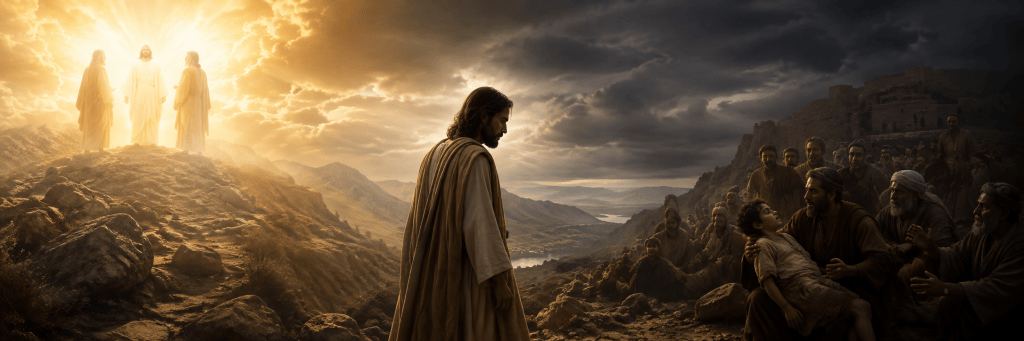
We often think about what the incarnation meant for us—and rightly so. God came near. The Word became flesh. Jesus entered our world to save us. But have you ever considered what the incarnation meant for Him?
For Jesus, Bethlehem was a step down. Paul tells us that although Christ existed in the form of God, He did not cling to the privileges of His divine glory. He “made Himself of no reputation,” took the form of a servant, and became a human (Philippians 2:6–8). He did not cease being God, but He willingly exchanged the environment of heaven’s glory for the environment of human brokenness. The incarnation was not an advancement for Jesus. It was a voluntary descent.
Perhaps we catch a glimpse of the weight of that descent in Matthew 17. Jesus had just been on the Mount of Transfiguration. For a brief moment, the veil was pulled back and His glory shone. Then He came down from the mountain and immediately encountered a desperate father, a tormented son, powerless disciples, and pervasive unbelief. Standing in the middle of it all, Jesus said, “How long shall I be with you? How long shall I bear with you?” (Matthew 17:17).
Think about that. The One who had known the glory of the Father before the world existed was now living in the middle of a fallen world. Perfect holiness surrounded by sin. Perfect truth confronted by unbelief. Perfect love encountering stubborn and hardened hearts.
Later, as His earthly mission drew to its conclusion and the cross stood immediately before Him, Jesus prayed, “Father, glorify Me together with Yourself, with the glory which I had with You before the world was” (John 17:5). Jesus knew what He had left. He knew where He was going. And He knew what stood between the two—the cross.
But notice what He said just before asking for that glory: “I have finished the work which You have given Me to do” (John 17:4). He would return to glory, but He would not abandon the mission to get there. He had come to do the Father’s will, and He would stay until the work was finished.
That makes His words, “How long shall I be with you?” even more moving. He asked how long—but He did not leave. He stayed. He healed the boy. He continued teaching His disciples. He kept walking toward Jerusalem. He endured misunderstanding, rejection, betrayal, suffering, and finally the cross.
Hebrews tells us that it was “for the joy that was set before Him” that He endured the cross (Hebrews 12:2). The suffering was not the joy. The joy was beyond it. Jesus knew the glory from which He had come, anticipated the glory to which He would return, and yet willingly endured everything that stood between the two because there was a work that had to be finished.
He remembered the glory from which He had come. He experienced the brokenness into which He had descended. He anticipated the glory to which He would return. But He would not return until redemption’s work was finished.
That is the wonder of the incarnation. It is not simply that He came down. It is that He stayed. He stayed when humanity disappointed Him. He stayed when His own disciples failed Him. He stayed when the crowds rejected Him. He stayed when Judas betrayed Him. He stayed when soldiers mocked Him. He stayed when nails pierced His hands.
He stayed until He could say, “It is finished.” Then He returned to glory.
He knew what He had left. He knew what it would cost. He knew where He was going. And He stayed until the work was done.
That is how much He loved us. ©
–PGR


Leave a comment